Conference Matters international
The yin and yang of human and artificial intelligence
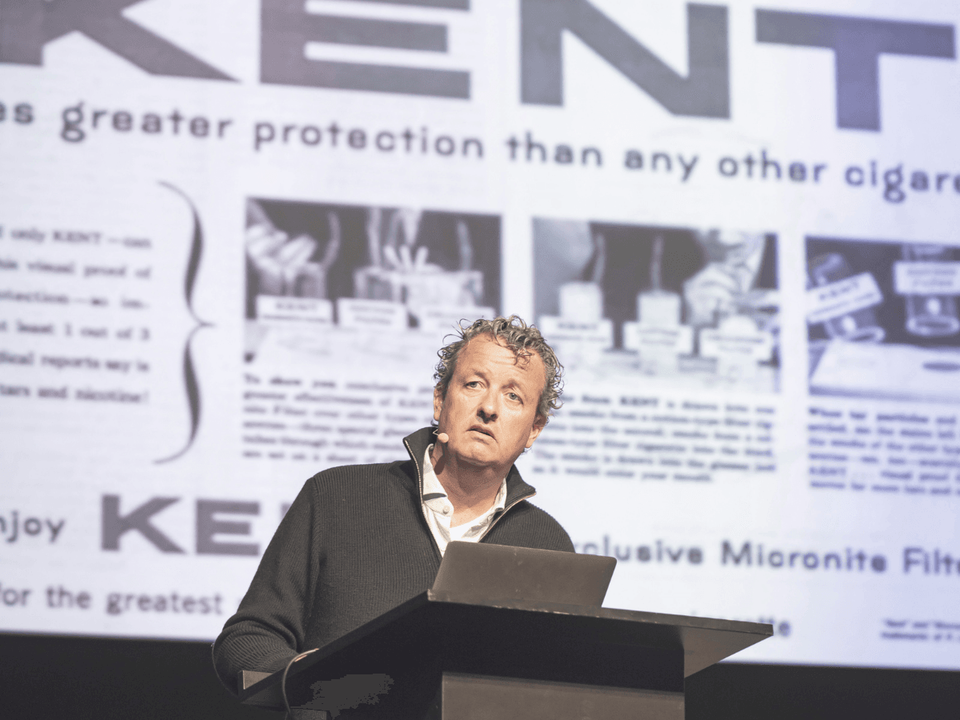
AI has stormed into our daily lives – professionally and personally. Yet we still rarely ask the most fundamental question: what is it that makes us human – human intelligence –, and how does that relate to what artificial intelligence does? That question was at the heart of HI-Day ’26, a congress organised by Publique, platform for live communication, on 13 April at World Forum The Hague.
Two speakers guided participants through the same unsettling landscape, each from their own vantage point: Haroon Sheikh, professor at Vrije Universiteit Amsterdam and Senior Researcher at the Netherlands Scientific Council for Government Policy (WRR), and Sander Duivestein, author and sought-after speaker on technology and society. A world that functions, but that no one truly understands – that was the shared point of departure.
Statistics that looks like thinking
Just before taking the stage, Sheikh takes a moment for a conversation in the Publique podcast. He is measured and sharp – too much the scientist to be swept up in the wave of AI panic that tends to dominate the public conversation. “We need to stop acting as if AI is gradually taking over from humans,” he says, as the auditorium fills up. “We are simply building a different kind of infrastructure.”
Sheikh has been researching artificial intelligence for years, and what strikes him most is not how intelligent AI has become, but how stubbornly the myth of its intelligence persists. “At its core, ChatGPT still does just one thing: for each word, it looks at what word is statistically most likely to come next.” That sounds trivial, but the scale makes it impressive. “Because it now works with very long texts, it looks as if the entire text has been thought through. But it is simply statistics.”
The computer system as authority
That nuance disappears the moment people read the output. Something kicks in that Sheikh calls ‘automation bias’: the tendency to treat a computer system as an authority. “When a computer says something, we behave as if it is a person with authority. We simply cannot help it.”
The most extreme example he cites is ‘death by GPS’: people who actually drive into a ravine because the navigation system told them to. “We have this tendency to treat computers as if they were people. That is already inherent in children, who also pretend that their dolls are just like people. Children fortunately learn to distinguish. We as a society still have that lesson ahead of us.”
‘We need to stop acting as if AI is gradually taking over from humans,’ Haroon Sheikh says. ‘We are simply building a different kind of infrastructure.’
In his lecture, Sheikh sketches a world in transition. AI has been in development for decades, but only recently did the second great wave break through: no longer pattern recognition, but pattern generation. Machines first learned to see what was there; now they are learning to create what does not yet exist. Text, voice, image and music can be produced from just a handful of seconds of source material. Through the digital traces we all leave behind – including in public spaces, via mobile phone tracking – ever more accurate personal profiles are being built, without a single cookie notification required
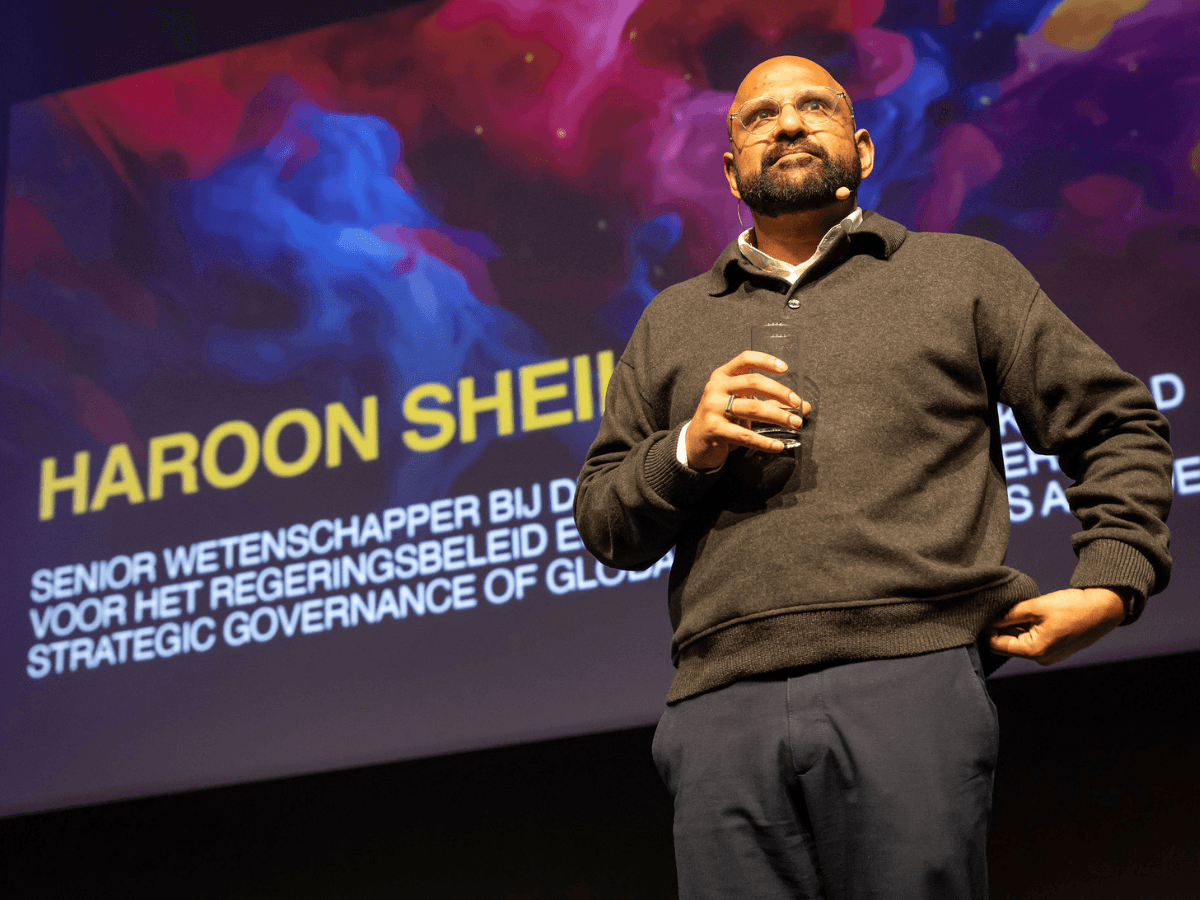
Haroon Sheikh: ‘When a computer says something, we behave as if it is a person with authority’
The wrong metaphor
And yet Sheikh refuses to endorse the standard doom narrative. His central argument is that we understand AI through the wrong metaphor. We keep modelling it as an imitation of the human being, as if the goal is to do everything we can do, only better. But that is like understanding a car as a faster bicycle. The function resembles that of a human, but the mechanism is fundamentally different – and so is the role it can play.
A car did not replace us as cyclists. It enabled us to do things we could not do before: holidays hundreds of kilometres away, cities that developed on an entirely different scale.
Large language models are demonstrably more effective at changing people’s opinions than other humans are. They tell us what we want to hear, inspire trust, and are increasingly being deployed deliberately for large-scale influence – through automated disinformation campaigns or the poisoning of training data with preferred narratives. This is not a future scenario; it is already current practice.
In the same way, AI will not replace human creativity or intelligence but extend its reach – creating new experiences we cannot yet imagine. The cobbler was not replaced by the factory. Mass-produced shoes made footwear accessible to everyone, and at the same time made the craftsman rarer and more valuable.
AI should therefore be understood as a new kind of entity. Not as an assistant, not as a tool, but as something for which we need to invent an entirely new category. And like any being, it must be socialised: trained on what it may and may not do, aligned with human goals, and kept in check by people who feel responsible for it.
The infocalypse and the price of convenience
Where Sheikh is the philosopher, Duivestein is the observer whose nose is pressed against reality every single day. Backstage at HI-Day – just before his presentation – he describes himself as a researcher rather than a trend watcher. “Crystal-ball language and grand predictions are not for me. I prefer to stay as close to the truth as possible.”
The fear dominating public debate – AI is taking jobs; people are becoming obsolete – is not one Duivestein shares. “I have never seen a technology that creates such a stir. But I do not believe the dystopian stories.”
What he does see is how the technology has fundamentally changed his own daily work. “I use it constantly. I can no longer do without it.”
But it is precisely that indispensability that keeps him on guard. In his presentation, he treats the audience to a flood of images and videos of fakes: fabricated news footage, generated music, manipulated profile pictures, advertisements for non-existent holiday destinations, staged interviews.
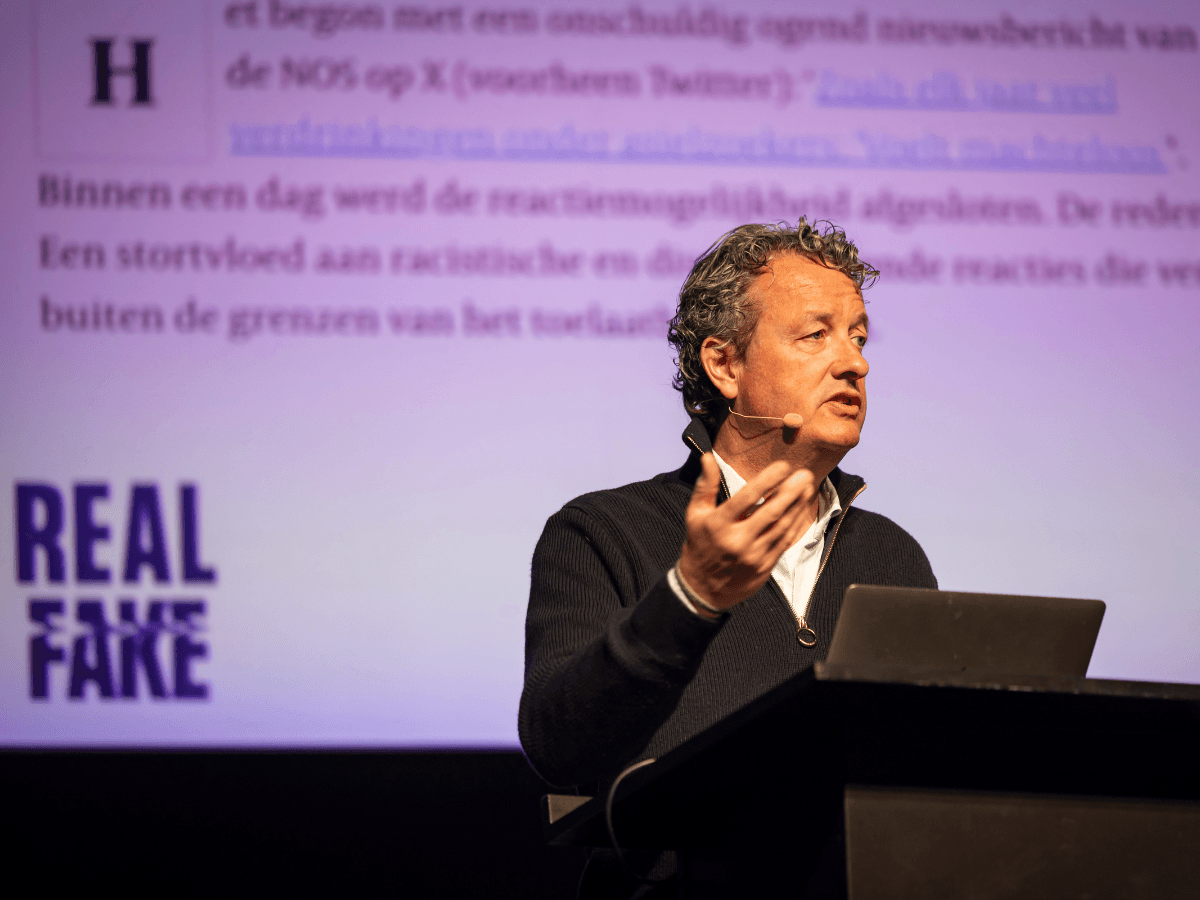
Sander Duivestein: ‘My greatest fear is that people simply stop thinking for themselves’
There is talk of the infocalypse: since November of last year, AI has been generating more information than humans do, and collectively we can no longer determine whether something is real or fabricated.
Duivestein is not only worried about the content of that stream, but about what it does to the people swimming in it. Young people are growing up with AI as a self-evident part of their lives. Not as a tool, but as an operating system. They ask AI what to eat, where to go, which choices to make.
“My greatest fear is that people simply stop thinking for themselves. You see it at universities: students submit dissertations without knowing what they are about. That is not smart.”
It is in our nature, he says. We are creatures of comfort. We always take the path of least resistance. And AI makes it extraordinarily easy to do exactly that. “But we need to step off those easy paths and seek out friction. Push yourself a little, to get something truly excellent out of it. Otherwise it stays superficial. Knowledge does not stick when you remove the effort.”
Three models and a better text
Duivestein uses AI intensively. He had his entire road trip through the United States planned by AI – which produced an excellent holiday. For his writing too, AI is an essential tool. He typically works with three models simultaneously, which under his direction generate ideas and texts, debate them and sharpen them up. This approach forces him to go deeper than the first answer. As a result, an article takes him no less time – perhaps even more – but yields more original angles and better texts.
It is an attitude he regards as essential: use AI not to reach a conclusion faster, but to arrive at entirely different insights about your own work.
His warning to organisations and policymakers is clear. Awareness is lacking. Regulation is lagging behind. “Legislation has been hopelessly behind reality for years. And when you finally get it made, it needs to be well constructed. That takes time. For now, it is the Wild West: everything goes, anything can be plagiarised.”
Skin hunger as compass
Duivestein wrote a column for the Financieele Dagblad [Financial Daily] about how human contact is becoming scarcer – and therefore more precious – in a world dominated by AI. For the meetings and events industry, that is not a threat but an opportunity.
He brings up the concept of ‘skin hunger’ that emerged during the coronavirus pandemic. “I found it such a telling description for what makes us human. We can look each other in the eyes, touch one another. And it is so tempting to throw all of that overboard and trust AI instead.” Young people are already doing this, he observes with concern: they go out less, are lonelier, hide behind screens.
That does not mean technology has no place at events. At any conference or event, you are already a data point as an attendee, and smart technology can help you find the right people.
Sander Duivestein: ‘Since November of last year, AI has been generating more information than humans do, and collectively we can no longer determine whether something is real or fabricated.’
But after that, Duivestein insists, the phone goes in the pocket. The key word for the near future of events, in his view, is authenticity. “We crave real things, real people, real performances, real stories. Not something assembled digitally off the shelf.” As an example, he cites Justin Bieber’s performance at Coachella – alone on stage, looking back at his own past, singing with the younger version of himself. “He placed a kind of meta-layer over himself. But it was also deeply personal, so pure. It gave me goosebumps.”
Sheikh shares that analysis. For the meetings and events industry, he sees not an impending end but a transformation. “The live experience will change and become far more mediated. But AI can guide us in other ways: deepening an experience, providing background knowledge, bringing the past to life.”
The discussion, he says, too often centres on whether humans are irreplaceable, or whether it will all be done by AI in the future. “What is meaningful is to look at the middle ground.”
The value of messiness
What connects both stories is a paradox worth dwelling on. The more AI can do, the scarcer the human interaction becomes – and therefore the more valuable. And that is precisely the domain of meetings and events. The real encounter. Presence without a screen. The silence in a room after someone has said something that truly hit home.
Duivestein closes his presentation with advice that is as simple as it is meaningful: let us be human. Embrace the messiness of existence. Technology does not remove the uncomfortable sides of human contact – and that is a good thing. The unexpected connection, the moment that does not go according to script, the conversation that ends up somewhere else entirely – that is not a shortcoming of live communication. That is its very essence.
Sheikh frames it in his own analytical way: anyone seeking to form a view on the interaction between human and artificial intelligence would do well to ask themselves two questions. First: what new experiences does AI make possible that would be unthinkable without it? Second: where does the human added value lie – the value that grows precisely because of scarcity?
The answer to the first question demands curiosity and a willingness to experiment. The answer to the second lies in the discipline not to delegate everything to technology – and the courage to embrace messiness as a source of genuine meaning.
That is the essence of the meetings and events industry. And perhaps also the lesson of HI-Day ’26.
Skills on their way to the museum
Haroon Sheikh warns of two tendencies. The first is the disappearance of human skills into what he describes as a kind of museum of human effort. Writing by hand, navigating independently, reasoning for yourself: these are skills that are slowly ceasing to be a matter of course.
The second is the transition to a world that functions excellently, but that no one understands any more – neither how nor why. We already barely rely on our own sense of direction; before long, the same will apply to almost everything around us.
Deel dit bericht
Reacties
Er zijn nog geen reacties.
Plaats een reactie
Je moet ingelogd zijn om een reactie te plaatsen.