
The congress as a policy instrument
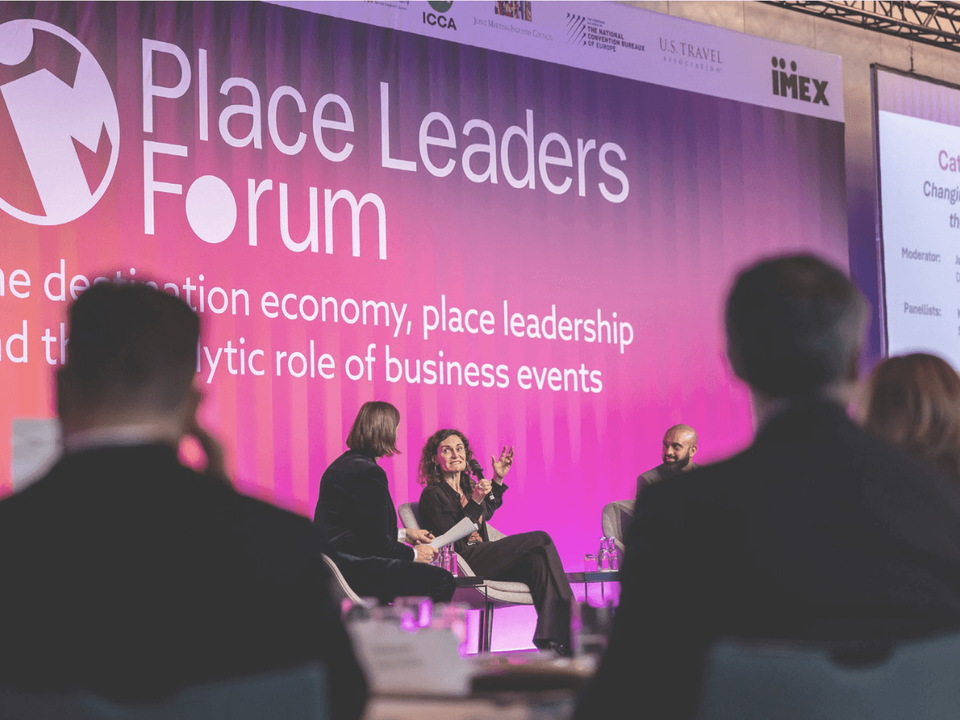
A new IMEX report by cities expert Greg Clark and Borane Gille argues that congresses are no longer a tourism product but an instrument of economic policy. For international associations, that also shifts the question of what a destination has to offer.
Destinations no longer compete solely on meeting space, hotel rooms and an attractive congress package. According to a report published by IMEX in July, winning an international congress increasingly comes down to a different question: what does a city, region or country want to achieve with it?
In Place leadership and the business events sector, Professor Greg Clark and Borane Gille of The Business of Cities argue that the business events sector deserves a seat at the table where decisions about a destination’s economic future are made. Their argument draws on 27 case studies from around the world, from Amsterdam to Auckland and from Copenhagen to Cape Town.
Competing for everything that moves
Their starting point is that the world has changed. Remote working, digitalisation and an increasingly mobile population have blurred the lines between visiting, working, studying, investing and living. As a result, cities are competing not only for tourists, but also for talent, students, capital and businesses. The authors call this the ‘destination economy’, in which the innovation economy and the experience economy converge.
Congresses occupy a special place in this picture. An innovation district or a museum is simply there; a congress has to be won. According to the authors, a destination that secures a major international congress shows that it is serious about a sector, well governed and able to welcome the world. What is more, a scientific congress attracts more than just delegates; some of them later return as researchers, students, entrepreneurs or even residents.
A blind spot
Yet in most destinations, the business events sector still plays only a supporting role in economic policy. That is not because the sector is actively excluded, Clark and Gille write, but because it has historically allowed itself to be defined as part of tourism and hospitality. Success was measured in room nights, delegate spending and venue occupancy. Convention bureaus often functioned as the delivery arm of a marketing organisation rather than as a strategic partner in economic development.
In the authors’ view, this has left an opportunity untapped. Congresses bring together precisely the people a city needs to realise its economic ambitions: researchers, businesses, investors and policymakers. The report sets out seven recommendations. These include a single strategic narrative for the whole sector, permanent seats on economic and innovation councils, shared methods for measuring impact and legacy, and new funding models.
What this means for associations
For international associations, this is no abstract policy debate. It changes what they can expect from a destination. A growing number of convention bureaus first assess whether a congress fits the economic priorities of their city or country. They then offer more than a venue: access to local clusters, universities and government.
Denmark shows how this works in practice. Through its Valuable Meetings programme, MeetDenmark links four congress destinations each to a national industry cluster – Destination Fyn to Odense Robotics, for example. Bids are made only when a congress aligns with the priorities of the cluster, the university and the region. According to the report, this approach has delivered a 66 per cent conversion rate in robotics, with ISARC, the construction robotics symposium Odense will host in 2027, among its biggest successes.
‘A bureau cannot become an intelligence hub on a marketing budget,’ the researchers observe.
Legacy is also coming into play earlier in the process. The legacy framework launched by the Barcelona Convention Bureau in 2025 links each congress to a local challenge. For instance, ECTRIMS, the multiple sclerosis congress with more than 9,600 delegates, led to an online training programme for Catalan employers on recruiting and supporting employees with MS.
In Sydney, BESydney worked with the New South Wales Department of Education in connection with the 2025 International Astronautical Congress. The closing public day attracted more than 10,000 visitors.
For an association, a destination that acts as a strategic partner can enrich the association’s congress programme and increase its societal impact. At the same time, this calls for an early conversation about goals, partners and expectations – ideally during the bidding phase.
The Amsterdam example
The Netherlands is represented in the report by Amsterdam. The Amsterdam Convention Bureau is part of amsterdam&partners, a public-private foundation established in 2013 as Amsterdam Marketing, through a merger of organisations including the Amsterdam Tourism and Congress Bureau. With more than 750 partners, the organisation combines attracting congresses with investment promotion, talent attraction and resident engagement. Sustainability and liveability frame all of the city’s major economic strategies, including its doughnut economics model.
According to the case study, Amsterdam deliberately prioritises quality and relevance over volume. Congresses are assessed on their contribution to local ecosystems, the major transitions facing society and lasting impact. That impact is shaped from the outset in partnership with cultural, academic and business partners, and aligned with the city’s key sectors: life sciences, technology, sustainability and the creative industries. Rotterdam Partners is also mentioned, as a variant on the same integrated model.
No guarantee
The authors are not blind to the obstacles. Many bureaus are funded through tourist taxes or similar levies, which reward volume rather than strategic value. A bureau cannot become an intelligence hub on a marketing budget, they observe. Measuring knowledge transfer and innovation over the long term is also difficult in practice.
For Clark and Gille, integration into economic policy is therefore no guarantee of success – but it is an opportunity. For associations choosing a destination, the report offers a useful test: ask not only what a city costs, but also what it wants to achieve with your congress.
Deel dit bericht
Reacties
Er zijn nog geen reacties.
Plaats een reactie
Je moet ingelogd zijn om een reactie te plaatsen.