
Conferences
Sustainability goals belong in the very first briefing
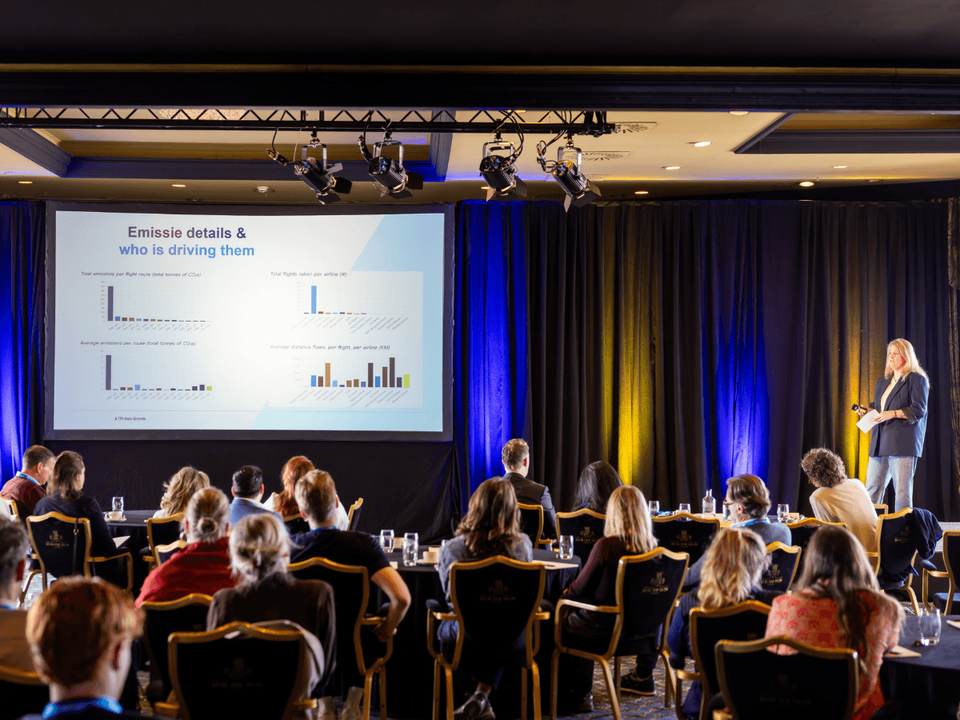
MPI Netherlands brought event professionals together on 30 March at Grand Hotel Huis ter Duin in the coastal city of Noordwijk for an afternoon of concrete insights and sharp debate on reducing the CO2‑footprint across the entire meetings chain. Consultancy firm EY demonstrated how sustainability works in its own operations. Travel and event management company ATPI showed how data makes the impact measurable. Together, speakers and participants concluded that the sector is still very much writing the ‘playbook’ for sustainable events.
The session was emphatically interactive: questions were put to the audience throughout. For example: “What share of the CO2‑footprint of an international event is attributable to travel to and from the venue?” The majority estimated more than 50 percent, but in reality that share often exceeds 75 percent at international events, explained Janneke van Aartrijk, Sustainability Events Manager at ATPI.
Claudy te Boome, Senior Manager Corporate Responsibility & Sustainability at EY, made that impact tangible with the Global New Partner Programme, an annual large-scale event at which incoming partners become co-owners of the firm. Each edition generates approximately 6,000 tonnes of CO2 emissions – comparable to the annual emissions of roughly one-seventeenth of all Dutch households and requiring 300,000 trees to grow for a year to offset it. A Dutch employee flying to such an event alone – often in business class – generates around 80 percent of what an average Dutch person generates in an entire year.
Measure, reduce, then offset
Van Aartrijk presented ATPI HALO as a tool that makes the data behind business travel and events visible. The approach consists of three inseparable steps: measure, reduce, and only then offset.
Simply offsetting emissions at the end of an event – the familiar carbon offset – and assuming the job is done falls short, Van Aartrijk argued. The real work lies in the choices made before and during the planning process: flight class, aircraft type, the ratio of business class to economy – all these variables determine the final emissions figure and mean that pre-event estimates can differ considerably from the post-event measurement.
Travel accounts for three-quarters of the CO2 footprint at international events
A recurring theme in her account: ‘data is messy’. Not all suppliers provide the same information, and some offer ready-made calculations whose underlying methodology is unclear. Anyone wanting to compare like with like therefore needs a single standard measurement method and, preferably, ISO-certified tools. ATPI works with an external partner for this, one that carries out the calculations using a fixed methodology.
Carrousel
The base year: more than a calculation
Many organisations struggle to establish a reference year for their sustainability targets. The COVID‑years of 2020 and 2021 were so atypical that they provide no representative baseline, which is why ATPI is regularly asked to recalculate a realistic base year.
Te Boome showed what this looks like at EY. Globally, the organisation operates with a science‑based target of a 50 percent reduction compared with 2019. In the Netherlands, this means a further 15 percent reduction is still needed before 2030. That percentage varies by country. Teams in Switzerland, for example, who travel a great deal for large, internationally operating financial services firms, simply accumulate more flight kilometres and therefore face a higher bar.
Does sustainability policy on matters such as catering, venues and print really make a difference if three-quarters of the CO2 emissions are already locked in by the flight tickets? MPI Netherlands members thought so – and that is why tips and creative solutions were gathered through statements, case studies and roundtable discussions. One example: a give-away buffet to enable more personalised choices and thereby less waste.
One recurring counter-question from the floor in response to the cases presented was: what is the objective of the event? That, after all, remains the most decisive factor in determining whether a sustainability solution is acceptable.
Front-runners do not wait for regulation
The CSRD (Corporate Sustainability Reporting Directive) came up repeatedly in the discussion. Larger companies with revenues above 50 million euros are feeling increasing regulatory pressure and are asking their suppliers and service providers more – and more probing – questions about sustainability. This group is often also the most advanced, because they have been investing in this area for years. But the number is growing: more parties are realising that regulation and reporting‑requirements are coming.
The most sustainable companies do not wait for that legislation, Te Boome and Van Aartrijk emphasised. EY operates with a global reduction target that is closely monitored and makes that commitment public. “Our overall big boss really does not want to report in the annual review in two years’ time that we still haven’t got there”, said Te Boome. Such public commitments generate an internal pressure that proves more effective than many external rules.
At the same time, a participant pointed to a bitter paradox: the biggest polluters – internationally operating corporates – also generate the most resources to reduce and offset their emissions. Meanwhile, event suppliers who are genuinely making their operations more sustainable often face severe margin pressure. The effort required should, in principle, be greater the larger you are.
Mapping the supply chain
One of the most concrete insights from the EY‑case is how the organisation scrutinised its own supply chain. For the first time, EY Netherlands explicitly included supply chain emissions – from all purchased products and services – in its annual report. The first step was based entirely on financial data multiplied by standard emission factors: not a perfect picture of what suppliers actually do, but a useful map of where the greatest impact lies.
The next step is a shift from a spend‑based to an activity‑based approach. EY is sitting down with its largest suppliers to collect specific emissions data. Globally, Microsoft turned out to be the largest supplier and therefore the logical first conversation partner.
For the events industry, this means: know which venues and suppliers offer the greatest opportunity for impact, start there, and actively request ESG‑scorecards or certifications. This also prevents every client having to draw up their own questionnaire from scratch.
Sustainability starts in the design phase
Many sustainability decisions are made in the design phase of an event and can barely be reversed afterwards. Te Boome illustrated this with an example: employees who wanted to travel by train to an event in Berlin discovered too late that the programme schedule did not align with train times. Had the programme started two hours later, everyone could genuinely have taken the train.
Three takeaways
1. Start with measuring, not offsetting. Without data there is no strategy: establish a realistic base year, measure consistently using a single method, and know where the greatest impact lies – most often in travel.
2. Build sustainability into the design phase. If venue selection and programme timing are fixed before sustainability goals have been formulated, you miss opportunities to structurally reduce CO2‑emissions.
3. Make it personal and open to discussion. Dashboards help, but the real difference is made in conversations with employees, suppliers and participants. People do not change their behaviour because they have to, but because they understand why.
That is why it is essential to include sustainability goals in the very first briefing and to link them directly to the programme and venue selection. Think of centrally located venues that minimise total travel distance, two smaller regional gatherings instead of one international event, and – if you do go international – programmes that encourage participants to stay longer, so that the travel investment delivers greater value.
Moving people: awareness and conversation
“Sustainability works not through prohibitions, but through awareness”, said Te Boome. EY therefore shows employees travel data at account level, making it visible which client generates the most flying, and shares best practices between offices.
One colleague who normally flew to South Africa three times a year decided to make one longer trip and train local colleagues, meaning she now only needs to go once a year.
Such choices do not arise of their own accord. They require data that enables people to think critically, as well as a culture in which people feel free to speak up. To support this, EY runs Climate Fresh‑workshops, an interactive card game about climate change, and finds that participants afterwards look differently at their choices – even seemingly small ones like the post-event buffet.
A Swiss colleague of Te Boome went one step further with one-to-one conversations with frequent flyers. Not as a check, but as an invitation to explore options together – for example, to show that other colleagues serving comparable clients travel half as much.
CO2 is only half the story
Finally, Te Boome emphasised that sustainability goes beyond the ‘green column’. Inclusivity ranks just as high on the agenda: can all participants take part, regardless of mobility, language or cultural background, and are venues, translations and visual support designed accordingly?
That is why EY deliberately chooses, wherever possible, venues with a PSO‑certificate (social enterprise), even when this takes extra effort within tightly structured procurement systems. Suppliers are routinely asked to sign a code of conduct covering environmental and human rights standards. A hygiene factor, as it was put – perhaps not spectacular, but indispensable.
Deel dit bericht
Reacties
Er zijn nog geen reacties.
Plaats een reactie
Je moet ingelogd zijn om een reactie te plaatsen.