
Conference Matters international
Ready to ditch the conference's worst habit for its cheapest fix?
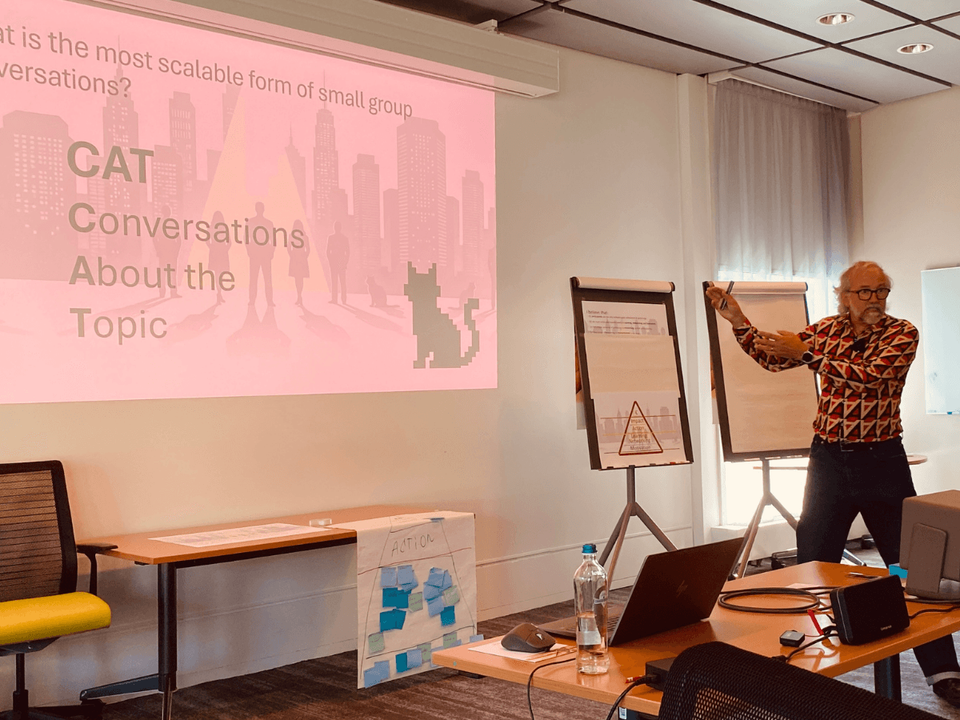
The one technique that makes every meeting better costs nothing, requires no training and fits any room layout. That is the proposition with which Maarten Vanneste spends three hours challenging an international gathering of meeting and event professionals. His message is as simple as it is uncomfortable: drop the Q&A, and let participants talk to each other about the subject.
Vanneste barely needs an introduction to this audience, which MPI Belgium brought together on 19 June at Dolce La Hulpe Brussels. He started his company Abbit Meeting Support in 1982 as an audiovisual service provider and then grew increasingly passionate about what he would come to call 'Meeting Architecture', the discipline he set down in his manifesto of the same name. He wrote the standard work on multi-hub meetings, founded the FRESH Conference, received the IMEX Academy Award and the MPI RISE Award, and eventually sold his company to devote himself entirely to his Meeting Design Institute.
What remained, he says, was a frustration: all those years of refined meeting design had produced something too complicated, too expensive and too poorly scalable. "I was looking for the simplest, cheapest thing that everyone can do and that changes everything."
That thing is called CAT: Conversation About the Topic.
Building the case in five questions
Vanneste builds his argument not with slides but with questions to the room. The first: what is the one thing you cannot leave out of a meeting? Objective, venue, technology, programme, speakers — each important, but each dispensable. A meeting without participants does not exist. Participants are the only indispensable component, and therefore, he reasons, we should design our meetings around them.
Why do those participants come? The room effortlessly supplies the three needs: learning, networking and motivation. Vanneste places them in the tradition of the ROI pyramid of Jack Phillips and Elling Hamso, with one intervention of his own: he separates learning and networking as two fundamentally different things. 'You do different things for networking than for learning.'
The hinge of the whole argument
The third question is the hinge of the entire story: what is the unique strength of a meeting? The answer, after discussion at the tables: human time, human contact, the trust you can only build by truly meeting someone. That, according to Vanneste, is the golden core of the sector. Learning can now happen anywhere: online, via a video platform, or if need be via an AI assistant. Bringing people together physically around shared expertise cannot happen anywhere else. 'That is our unique selling proposition. Uniquely powerful.'
And that, he continues, is precisely where we let it slip. Question four: what do we actually do to improve that networking? The honest answer is: almost nothing. We rely on serendipity; the coffee break as the networking moment. But in that break everyone walks over to the people they already know. Meeting a new person is, according to Vanneste, worth many times more than a conversation with an acquaintance, precisely because something new can come of it: a project, a client, an idea, a friendship. And yet we leave it to chance.
Unmasking the Q&A
Question five leads to the heart of it. Which interaction technique works best? Not a game, not a poll, not an exercise; all of those have their value, but the best is simply talking to one another. And what do we do instead, at virtually every conference in the world? The Q&A.
Vanneste dismisses this technique for achieving interaction altogether. The Q&A, he argues, is the worst technique the sector has, and at the same time the most widely used. In a room of a thousand people, one or two individuals talk to the speaker while the rest listen passively.
There is barely any activation and no interaction. "And the people who do grab the microphone often don't ask a question," he argues. "They make a statement, because they actually feel they should have been the ones on stage and want to show off their expertise. It gets me worked up. We waste five minutes on it every single time."
A case for Conversation About the Topic
The alternative, he says, was hidden inside the Q&A all along. CAT stands opposite Q&A as its mirror image: 'Conversation About the Topic' instead of 'Questions and Answers'.
The idea is that the people in a session are not a random group, but what Vanneste calls 'perfect strangers': people who do not know each other, who would never cross paths in daily life, but who at this moment, in this room, have been filtered for exactly the same interest.
Letting them talk to each other about the subject for ten minutes is, in his view, the fastest and highest-quality form of networking that exists. You immediately hear who someone is, what they know, whether this person has an answer to your question. "The fastest way to get to know someone is not at the bar over a beer," Vanneste adds.
Free and scalable
The best thing about CAT, in Vanneste's reasoning, is that it costs nothing. No facilitator, no training, no equipment, no budget line on the invoice. It scales from five people at a table to a room of four thousand, and it works in any layout — including an auditorium, where people turn around to the row behind them; the person next to them is often someone they already know, Vanneste explains.
The basic script he works out with the MPI participants looks like this. Take a one-hour session with a single speaker. Cut the presentation into three ten-minute blocks, with a CAT moment in between each, in which the room discusses at the tables what they have just heard. Tell the speaker they are giving a thirty-minute presentation, in three parts, even though the session is scheduled for a full hour on the programme. Count on roughly one slide per minute, and no animations. A table of five is optimal: four 'perfect strangers' plus yourself, three conversation rounds of ten minutes each. At tables of three or four, the number of new contacts drops too far.
Is it that simple in practice?
The participants question whether this can be applied as strictly as that in practice. Are most speakers willing and able? Possible adjustments come up, such as an introduction round, explicit feedback from the CAT groups to the speaker, music, a challenge with a prize, or a moderator.
All fine, says Vanneste, but beside the point. The point is: do CAT first in every session, and only start tinkering after that. "If you don't do this in every presentation, you're making a mistake."
It can also favour a different type of speaker, someone in the group notes. Not the keynote performer with a set routine, but the genuine expert who talks about the subject with passion and wants feedback from the room. There are advantages for the speaker too, Vanneste adds. They can relax for a moment during a CAT break, or walk around and be available for questions, or simply prepare for the next block.
The calculation that backs it up
To convince clients, Vanneste puts forward a financial exercise. What is one good new connection worth? Studies vary widely: from an average of around 1,500 euros to figures of 30,000 to 100,000 euros, and in some sectors a single new contract can generate millions per year.
A conference with only Q&A yields a participant an estimated handful of meaningful new contacts. Those present guessed at numbers between two and twenty-five, and settled on an average of roughly five. A conference with CAT yields about forty contacts in Vanneste's calculation. Scaled up to a full multi-day conference with several CAT sessions, he arrives at a claim of twenty times more value generated by new contacts.
A caveat is in order here, and Vanneste makes it himself. "It's just an example," he stresses. The value of the exercise lies not in its precision but in its effect: it is an eye-opener to put in front of a CEO or CFO, who is usually startled by what attending a meeting really costs, and can also deliver.
Measuring effectiveness is the hard part
Measuring networking remains the trickiest part, and it is discussed at length at the tables. Smart badges, post-event surveys, weekly follow-ups: all are mentioned, because the group also wants to factor the quality of the connection into the outcome. It can all be done, but it costs time, money and discipline that most organisations do not have, Vanneste argues. That is precisely why he opts for the opposite: not more complex measurement, but simple, measurable metrics. "Most people don't have that time. So I look for the one simple thing that everyone can do."
The emergence of mentor–mentee relationships
The story does not end with data, but with people. The younger generation learns online, travels less for training because budgets have been cut, and, according to those present, is becoming increasingly isolated. A hundred online friends, but almost no one they actually see. That is exactly what makes meetings — with networking as their most important component — more important.
At the CAT tables, mentor–mentee relationships form between a student and an expert with thirty years of experience; newcomers have enormous networking potential there. In the closing round, one participant sums it up crisply: it is about the human side, not the technical.
Freely downloadable materials
Vanneste gives his material away: the executive summary of his book Perfect Strangers as a PDF, a short video that 'unmasks' the Q&A, CAT slides for speakers, a whitepaper and a standard script. Free to use, free to share, no permission required. A way, he says, to give something back to the industry.
The rest is up to the sector itself: do we dare to let go of the conference's worst habit in favour of the cheapest improvement there is?
Deel dit bericht
Reacties
Er zijn nog geen reacties.
Plaats een reactie
Je moet ingelogd zijn om een reactie te plaatsen.