
Energy transition pioneer Frits Verhoef: ‘Using stories to return to our foundations’
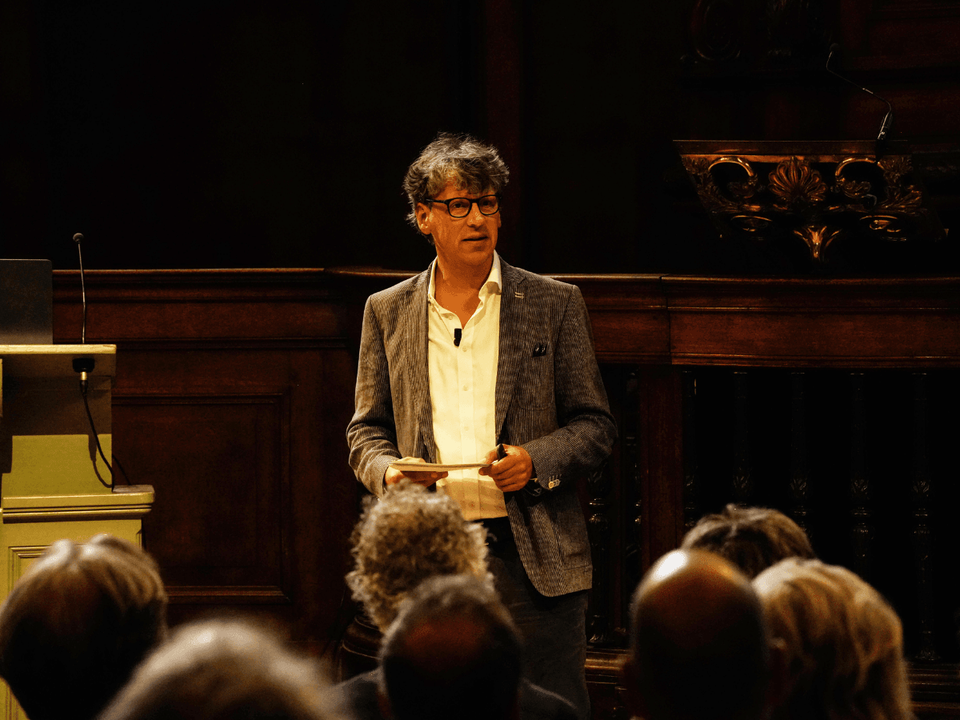
Frits Verhoef studied Applied Physics at Delft University of Technology and is regarded as a pioneer of the energy transition. In 2006 he founded a solar panel company and helped to build the energy transition. Today he is an impact entrepreneur, author and lecturer, and sits on the Supervisory Board of Follow This. Following Lef en moed (2018), his second book, Verhalen voorbij de toekomst (Stories Beyond the Future), was published this summer.
You decided to commit seriously to the energy transition as long as twenty years ago. How was that seed planted?
‘Somewhere in my childhood. Both my parents were politically active and concerned about the environment. At the time, in the 1970s and early 1980s, it was a subject that received a great deal of attention – with the 1973 oil crisis still fresh in people’s minds.’
‘My father kept track of the family’s gas consumption on graph paper. As children, we were trained to close the door behind us to save gas. After my father died, I found a good metre and a half of books on environmental issues in his house. That was the conversation at the dinner table, and unconsciously it was the seed that steered me in that direction.’
How did the subject then take hold of you?
‘I spent the first ten years after graduating in the corporate world. Then came the moment when I decided I wanted to do something more meaningful. One thing led to another and I found my way into renewable energy. That was even before Al Gore received the Nobel Peace Prize for his efforts to raise awareness of climate change.’
‘My mission to get to work on renewable energy, driven by the desire to do something about CO2 emissions, was also linked to my background at Delft, where you learn to come up with solutions.’
Your second book was published recently. What approach did you take, and why?
‘The energy transition was the subject of my first book. I wanted to make people aware of just how vast the issue is. As a tech optimist, I still believed back then that we would get the job done.’
‘Years later, I came to realise that this simply isn’t the case. The fact that I have spent twenty years contributing to the enormous growth of renewable energy is good news in itself. The bad news is that, over that same period, we have started using more oil than we generate from renewables.’
‘With Eisenstein’s model, everything fell into place for me’
‘That led me to this insight: if we don’t start talking about using less energy, we can keep building wind turbines and installing solar panels until the cows come home. It won’t solve the problem.’
‘There is also the realisation that raw materials are needed to make all those wind turbines, charging points and solar panels. We install things without asking ourselves how finite those raw materials are or where they come from. For me, that was the trigger to dig deeper. That is what I call the “stories beyond the future”.’
Could you walk us through an example of a story?
‘My account is based on a model by the American philosopher Charles Eisenstein. He argues that societal problems are symptoms of systems that rest on stories. Treating the symptoms alone – cutting CO2 emissions, tackling the plastic soup and so on – won’t get you where you want to be. You have to start from the bottom up: the foundation.’
‘Take smoking. As a society, we want to be rid of it. So what happens? We introduce regulation to curb it. Higher prices, a ban on smoking in public places. The tobacco industry responds with something new: vaping. Now that has to be regulated as well.’
‘The energy transition… So much has already been written about it, and we talk about it so often. It is in the news every day, so it is widely known and has sunk in. The students I teach on the subject need no introduction to it. Imagine my surprise, then, when I recently addressed a highly educated audience and several people still wanted the term explained. Because what was it again? Fossil fuels, er… We still have a way to go.’
‘But the underlying story is that we apparently find it acceptable for the shareholders of this industry to do this: getting as many people as possible to smoke in order to make as much money as possible. That is the foundation – the story – that needs to be tackled.’
‘We will have to look at ownership differently. Many people think it is some kind of natural law, but giving shareholders the power is something we came up with ourselves. With Eisenstein’s model, everything fell into place for me.’
How do you make sure this message sticks?
‘I like to show my audiences a scene from the recently released film How to Live on Earth, because it makes so much clear. In one of the largest pear orchards in the world, in China, thousands of people are busy collecting the blossom during flowering season. Machines have been built to extract the pollen – entire factory halls full of them. The workers then go back to the orchard with little bowls full of pollen to pollinate the trees. Now they are using drones as well.’
‘There is certainly still a bit of the preacher in me, but in the end it is counterproductive’
‘The underlying problem, of course, is that there are no longer any bees to do this work. We solve something – treating the symptoms – but the problem remains. Whereas the question should be: how do we bring back the bees? By not using pesticides.’
‘By knowing the story, perhaps we can bring about change together. It is the only way to solve all the crises we face on this planet.’
Which organisations or companies are particularly interested in your story?
‘When the focus was on the energy transition, the interest mainly came from energy companies and grid operators. This second book is much broader. Many large companies could benefit from it. The people who work there often handle only a small piece of the entire energy puzzle, so they don’t automatically see the bigger picture. Once the connections are clear, better solutions emerge, and that in turn can lead to better products for a better future.’
Do you have any special tools for keeping things light?
‘My enthusiasm and a dose of humour. For example, I show a line depicting a collapse to illustrate the need for change, based on the idea that if we get it right now, we can prevent collapse.’
‘Most people think of something like an atomic bomb explosion: the big disaster that ends everything in one go. Then I show them that we are talking about a slow collapse. And do you know what this graph is? Ajax’s UEFA coefficient, which has been steadily falling since the 1970s. Ha ha, that’s something they do remember.’
And how about your own footprint on this planet?
‘Too big as well, but we do our best at home. No flying; we go everywhere by train and bike. I don’t eat meat, which, incidentally, I don’t consider a sacrifice at all. There was a time when I felt a strong urge to persuade people to follow my example, but I now steer clear of that. There is certainly still a bit of the preacher in me, but in the end it is counterproductive.’
Finally: you must have one big, beautiful dream for the future of this world. What does it look like?
‘As human beings, we have drifted a long way from what and who we are: living in community with one another and with nature, as humans always have. I hope we rediscover our connection with each other and with the nature we are truly part of. If we manage that, I believe we are perfectly capable of making the right decisions.’
‘To a very large extent, the transition is one we have to make within ourselves. A few solar panels and wind turbines will follow in due course.’
Deel dit bericht
Reacties
Er zijn nog geen reacties.
Plaats een reactie
Je moet ingelogd zijn om een reactie te plaatsen.