
Conference Matters international
Destination Development Model maps how business events contribute to policy goals
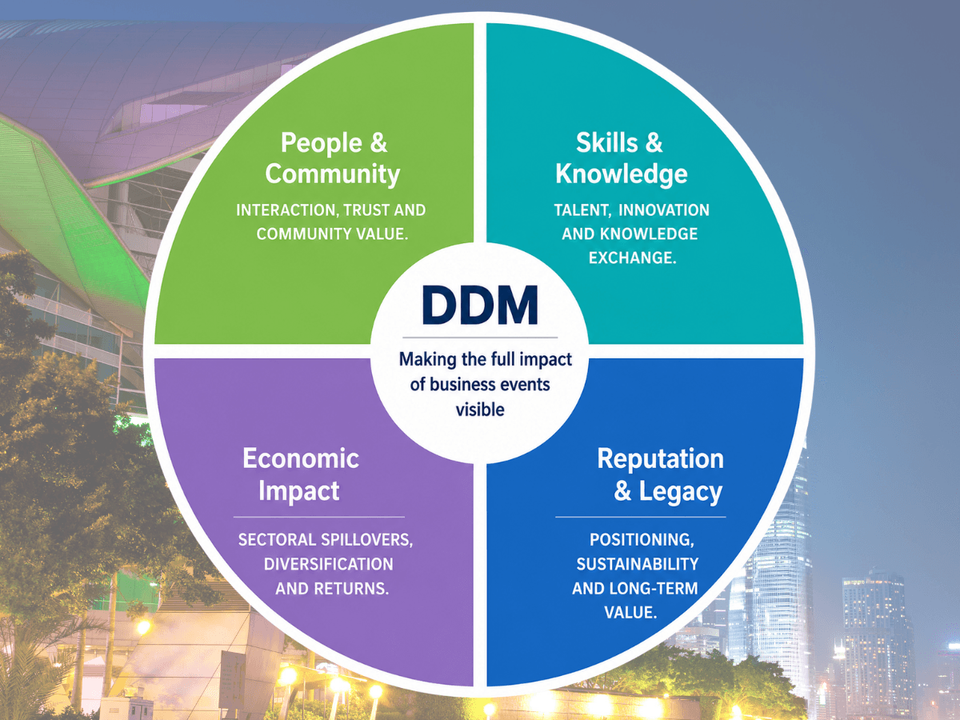
JWC, a global consultancy for the events sector, has introduced a new analytical model that helps city officials and destination marketers demonstrate how business events contribute to policy goals. The DDM – Destination Development Model – addresses the growing demand from governments for clearer evidence of the sector's long-term contribution, going beyond traditional impact metrics such as visitor spending, hotel stays, and economic impact.
Unlike conventional event impact studies, the DDM looks beyond the activities of exhibitors and visitors and assesses how event portfolios support broader public goals. It is designed as a decision model for destinations looking to align their event portfolios with policy and development goals.
“Destinations are not funded based on activity. They are funded based on results,” says Kai Hattendorf, partner at JWC. “The corporate events industry has been good at measuring output for decades: visitor numbers, expenditure, square footage, hotel stays. But governments think in terms of results: talent, innovation, resilience, sustainability, economic positioning, and social value. The DDM helps destinations link corporate events to that policy debate.”
Assessment on fifteen dimensions
The DDM assesses corporate events based on fifteen dimensions, grouped into four strategic impact clusters: People & Community, Skills & Knowledge, Economic Impact, and Reputation & Heritage.
Together, these clusters provide a structured picture of how events can support the development of a destination: from social value and talent development to economic resilience, international reputation, and long-term heritage.
The model connects three core elements: policy ambition, contribution of events, and measurable results. It starts with the strategic priorities of a destination itself and then assesses how corporate events contribute to the 15 dimensions of the DDM. By combining destination-specific data, industry indicators, and structured modeling, the DDM shows where events already support public goals, where gaps remain, and where future bidding, financing, or investment choices can strengthen results.
Pilot with Singapore Tourism Board
The completion of the first pilot phase with the Singapore Tourism Board (STB) marks the first major validation step for the DDM. The pilot tested the model's core architecture in a professional, policy-driven destination environment.
The STB provided policy insights, destination context information, and industry data for the Singapore-specific DDM analysis, enabling JWC to test the framework against the destination's actual priorities and data conditions.
Collaboration with Singapore Institute of Technology
The pilot project also included an academic research component with the Singapore Institute of Technology, where students investigated potential data points and sources that could be linked to the model.
Ong Huey Hong, Deputy Director of the Industry Development Group at the Singapore Tourism Board: “The DDM pilot project offers a structured way to examine how business events can generate meaningful results for the destination that extend beyond the event itself. As the world’s leading MICE city, Singapore’s ambition extends beyond tripling our revenue from business tourism by 2040. We want to ensure that growth is supported by sustainable value for our destination, industries, and communities, and the DDM provides us with a substantiated framework to demonstrate this.”
Deel dit bericht
Reacties
Er zijn nog geen reacties.
Plaats een reactie
Je moet ingelogd zijn om een reactie te plaatsen.