
Conference Matters international
Conference and trade show attendees want to learn more outside the room
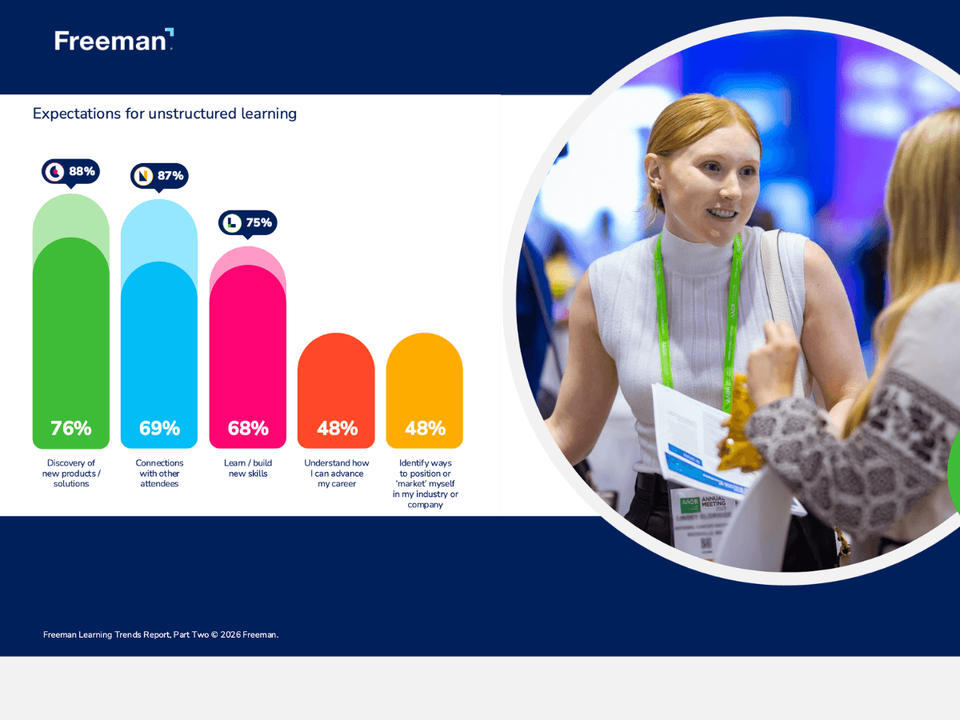
Conference and trade show attendees are increasingly viewing the entire event environment as a learning environment, rather than just the lecture hall or the keynote stage. This is evident from the second part of the Freeman Trends Report *Unpacking XLNC: The Future of Adult Learning at Conferences and Trade Shows*, published by the American event company Freeman on July 23. According to the research, attendees would ideally spend 54 percent of their learning time outside traditional session rooms. At trade shows, that share rises to 64 percent.
While organizers continue to invest heavily in conference sessions and keynote programs, Freeman notes that attendees are attaching increasing value to learning that takes place through conversations with peers, interactions with exhibitors, hands-on demonstrations, and informal exchanges throughout the entire event.
"Learning does not begin the moment attendees take a seat in a session, and it does not stop when they leave the room," states Ken Holsinger, SVP Strategy at Freeman. According to him, visitors learn on the exhibition floor, in conversations with peers, through demonstrations, and in contact with subject matter experts. The challenge for organizers is to consciously design those experiences.
Networking equals formal sessions
The report reveals that visitors find learning through networking conversations and contact with exhibitors slightly more valuable than traditional conference sessions. According to Freeman, this indicates that the most meaningful insights often stem from discussion, demonstration, and shared experiences.
This shift is reinforced by younger target groups: two-thirds of emerging generations say they need more learning opportunities outside of traditional venues, underscoring the demand for more flexible, interactive, and experiential learning environments.
Attitudes towards sponsored content also appear to be more nuanced than is often assumed. 84 percent of visitors have a neutral to positive attitude towards sponsored sessions, provided the sponsorship is clearly disclosed; only 16 percent have a negative view.
In this regard, the relevance of the topic outweighs the question of who sponsors the session. Furthermore, only 19 percent of visitors cite earning continuing education credits as an important reason for attending an event.
The exhibition floor as a conscious learning environment
The findings align with previous research by Freeman, which showed that visitors attach more value to practical demonstrations, access to experts, and concrete insights than to short content or passive presentations.
According to Freeman, this offers organizers, education managers, and exhibitors the opportunity to rethink how knowledge transfer is structured, by treating the exhibition floor, exhibitor activations, mutual exchange, and sponsored sessions as consciously designed learning environments.
Over 3,300 visitors and exhibitors at conferences and trade fairs were surveyed for the study. The full report can be downloaded here.
Deel dit bericht
Reacties
Er zijn nog geen reacties.
Plaats een reactie
Je moet ingelogd zijn om een reactie te plaatsen.